
Using Force Plate Metrics to Guide Speed Training:
Smarter Decision Making & Better Decisions for Athlete Development
Note: the ideas below are more geared towards teenagers 14-17 years old with low to moderate training experience. There’s some carry over to younger athletes but they are in a different bucket when it comes to training prioritization.
“He’s already pretty strong, he just needs to get faster.” We hear it ALL…THE…TIME from the parents of 14-17 year olds. Oftentimes, they are right. Their kid IS strong but not all strength transfers to athleticism. So when we put them on our force plates, the data doesn’t lie. The truth is, most kids in this age range, typically lack the requisite strength to improve their speed, vertical, and overall explosiveness. But mom & dad are on the right track—they do need more speed. What gets missed is that speed development isn’t just trained, it’s earned through strength and capacity first. This concept applies to more to than just speed work, it’s really any sport specific training. Whether it’s pitching, hitting, kicking, jumping, running routes.. your ceiling will always be defined by how much force you can absorb and redirect.
The Law of Diminishing Returns
In this early teen demographic, strength training drives speed development. Getting stronger improves how much force a young athlete can put into the ground, which is the foundation of acceleration and top-end speed. It doesn't mean that speed work should be neglected but it’s not our focus. The focus is on building a foundation of inputs such as single leg strength, hip stability, foot & ankle stiffness. That said, the law of diminishing returns eventually sets in and adding more strength gives little return. So what is strong enough? When do you change gears to focus more speed/sport specific training? Furthermore, are the strength training applications and programs actually working? In the past, we guessed and assumed. And as you can imagine most coaches bias was towards more strength training.
This is where technology changes the game.
Using force plates (like our system from Hawkin Dynamics), we can objectively measure how an athlete produces and absorbs force. Instead of guessing, we can see when an athlete has enough strength and needs to shift focus toward power and speed.
3 key metrics to road map an athlete’s training
Relative Peak Propulsive Power RPPP – how much explosive force an athlete can produce relative to their bodyweight. This tells us how effectively they’re turning strength into usable speed. This is measured in W/kg. Simply, put, an athlete with low RPPP can’t produce enough power relative to their body weight and needs to get stronger. Once an athlete gets above 65 W/kg we can have real conversations about speed training and more sport specific needs.
Propulsive Power Benchmarks (High School & College)
45–55 W/kg → Average. This is where we see the average varsity athlete during initial assessments. Underclassmen are usually below average. Athletes in this range simply are not producing enough force to get any benefit from traditional speed training.
55–65 W/kg → Good.
65–75 W/kg → Very Good (pretty much all of our collegiate athletes and experienced high school guys are in this range.
75–85 W/kg → Elite (The only High school guys we see here are Division 1 prospects).
85+ W/kg → High-level outlier
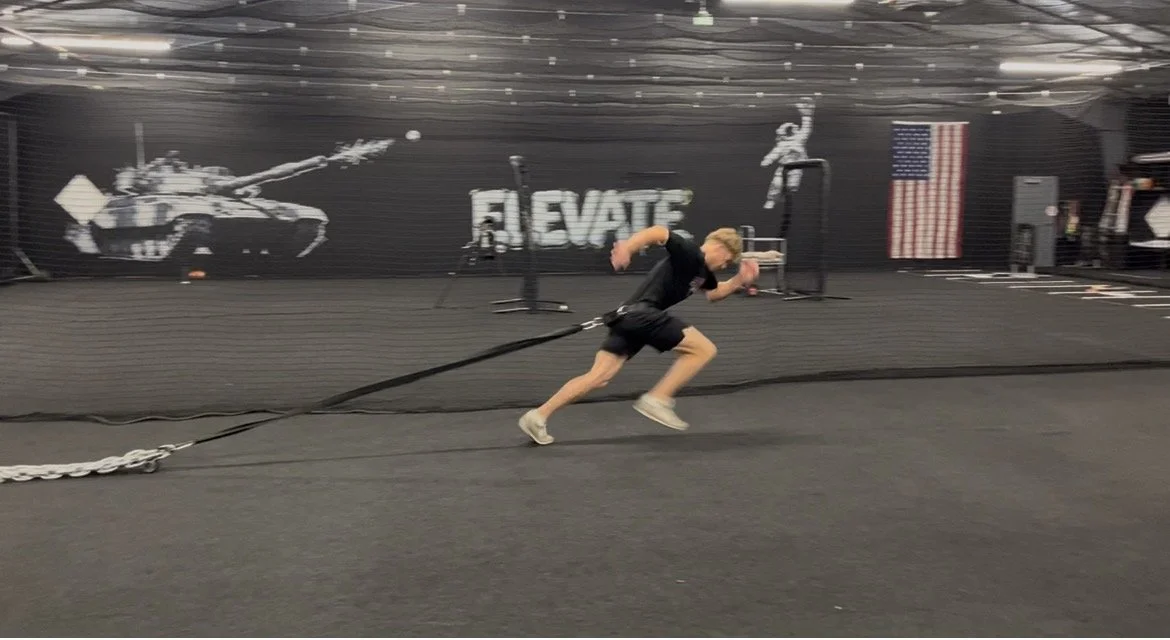
2027 Tyler Feldhake has been training with us since he was `14, he has the highest Relative Propulsive Power Output (85 W/kg) of anyone in The Factory, ever. Safe to say he doesn’t really need to get stronger. Now he needs to build his brakes, continue to build elasticity and reactivity, and learn how apply his power to sport specific movements such as sprinting.
Braking Rate of Force Development (RFD) – how quickly an athlete can absorb force. This is critical because…Your athlete’s central nervous system (CNS) acts as a governor. It will only allow them to produce as much force as they can safely absorb. If they can’t decelerate or control force efficiently, the body will hold back output as a protective mechanism. In simple terms: you can’t be powerful if you can’t control power. At top sprinting speeds, athletes typically apply about 3-5x their bodyweight into the ground during each step; that’s a lot of energy & force that needs to be absorbed, stored, redirected. Building better brakes is at the core of everything we do with our athletes. And make no mistake, our best athletes have the best brakes!
Reactive Strength Index (RSI) - Once an athlete has built the necessary strength base, we shift toward more elastic and reactive training. That’s where metrics like Reactive Strength Index (RSI) come into play. RSI measures how quickly an athlete can transition from absorbing force to producing it—essentially, how “bouncy” and efficient they are.
The takeaway for parents and young athletes: getting faster isn’t just about doing more speed drills. It’s about building the right foundation, knowing when to shift gears, and using the right data to guide the process.